
Business security camera installation for an Atlanta law firm means cameras on the entrances, the reception counter, the corridors and the doors to the records room and network closet, with sound switched off and no lens anywhere a client meets counsel. ClearMax technicians install the cameras and the recorder on site as part of the buildout, and the firm owns the footage and the accounts that reach it.
Last updated: November 2026
What should a law firm's cameras actually watch?
Movement, not conversation. The questions a firm usually needs footage to answer are simple ones: who came in after hours, who collected that package from reception, who opened the records room on the Friday before a filing. A camera plan that answers those questions starts with:
- The main entrance, from inside, and from the corridor outside if the building allows it.
- Reception, covering the counter and the waiting chairs, so arrivals are on record.
- The records room door and the network closet door, matched with the readers on the access control page, so a name in the door log comes with a picture.
- Service and back doors, including any door to a stairwell or freight corridor.
- A ground-level entrance or parking area, only where the firm controls it and the landlord agrees.
In an Atlanta office tower, a short list of cameras usually covers everything that matters. The building usually records its own lobby, elevators and garage, and that footage belongs to building management. The firm's cameras begin at the firm's door.
Where do cameras never go?
Into attorney offices, conference rooms, interview rooms or anywhere a client talks with a lawyer. Those rooms exist for privileged conversations, and a recording of one is a record that should never exist. The same goes for restrooms, a nursing room and any break area where staff reasonably expect privacy.
Georgia law draws its own line in the same place. O.C.G.A. 16-11-62(2) makes it unlawful to use a device to observe, photograph or record the activities of another in a private place and out of public view without the consent of all persons observed. The statute excepts an owner or occupier using a device for security purposes, crime prevention or crime detection in areas where there is no reasonable expectation of privacy. The firm's own entrance, reception and corridors fit that description. A closed office or a conference room does not, and the plan treats it that way. Nothing here is legal advice; it is the reason the camera layout looks the way it does.
The rule is applied to what each camera sees, not just where it is mounted. A corridor camera that looks through a glass conference room wall is re-aimed or given a privacy mask in its settings. Many newer Atlanta floors use glass-fronted offices and conference rooms, so each view is checked live, on site, with the camera running, rather than trusted from the drawing.
Why are the cameras installed with sound off?
Because recording conversations is a different act from recording pictures, and a law office is full of conversations. O.C.G.A. 16-11-66(a) says the recording ban does not apply where the person is a party to the communication or one of the parties has given prior consent. That exception helps a person recording a call they are on. It does not describe a reception camera picking up a client and a courier talking to each other, neither of whom agreed to anything, and O.C.G.A. 16-11-62(1) separately prohibits clandestinely recording a private conversation that originates in a private place.
So the default on every law office project is simple: audio is switched off in each camera and in the recorder, and that setting is listed camera by camera in the handover record. Many cameras ship with microphones enabled, which is why each one is checked rather than assumed. The default is only changed on the firm's written decision, made with its own counsel.
Retention: how many days of video?
Long enough to answer the questions that arrive late. A firm rarely asks about the entrance on the same day; it asks two or three weeks later, when an invoice is disputed, a laptop is missing or a client says a document was never delivered. A recorder that overwrites itself after a few days cannot help with any of that.
So the firm picks a retention period, the recorder's storage is sized to hold it, and the period is written into the handover record. Longer retention means more storage and more footage the firm is responsible for. Shorter retention means less to protect and less to look back on. Either is reasonable if it is a decision rather than a default.
Georgia's breach-notice statute is a common point of confusion here. O.C.G.A. 10-1-912 places its notice duty on any information broker or data collector, and the Code defines a data collector as a state or local government body. For a private firm, the reason to keep and protect footage is the Bar's confidentiality duty and the firm's own practical needs. Any notice question belongs with the firm's counsel, not with its camera installer.
Viewing rights and the recorder
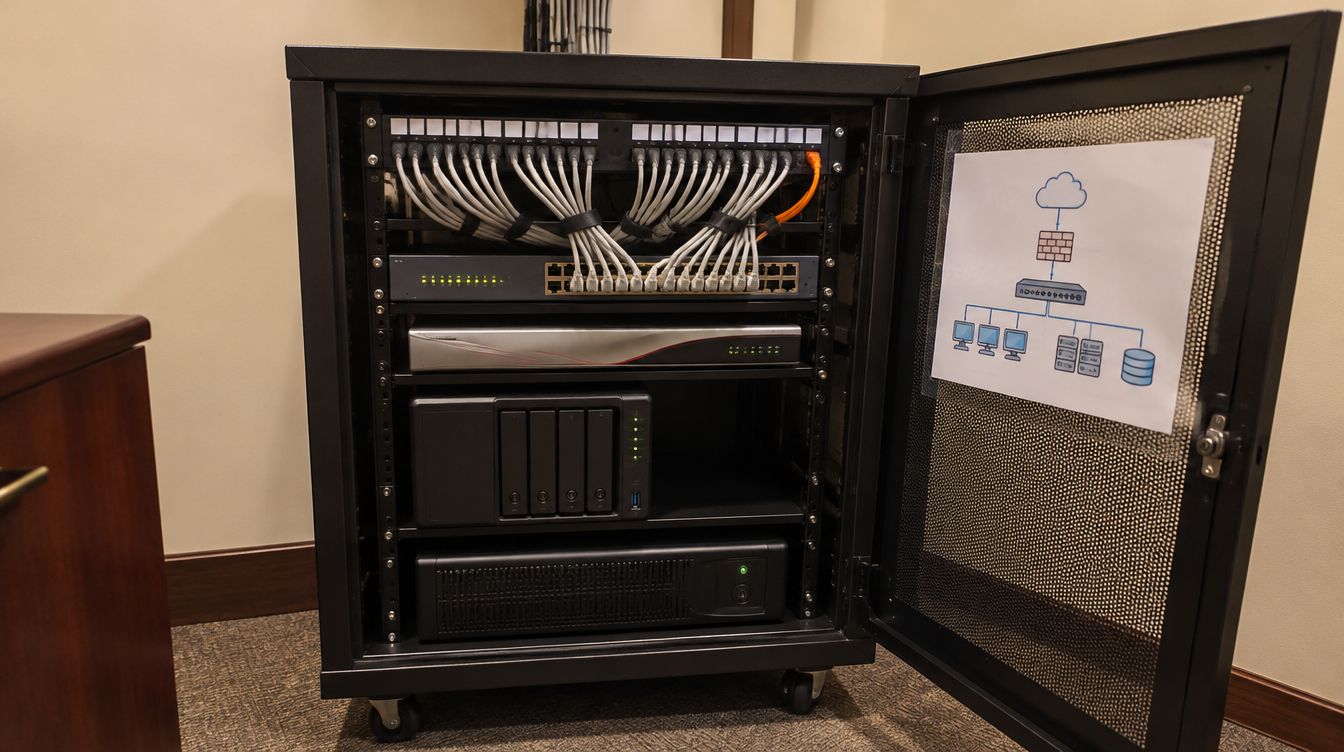
As few people as the firm can manage. The recorder sits in the locked network closet, and access is arranged so that:
- each viewer has a named account, never a shared login;
- watching and exporting are separate permissions, so copying footage off the system needs a deliberate decision;
- viewing from outside the office is only switched on if the firm asks for it, through the firm's own secure connection;
- administrator access is recorded in the firm's name and handed over at the end.
Cameras are cabled to the firm network and powered from the switch. They never join guest WiFi, and every default password is replaced before a camera goes live. The firm owns the system and its footage.
Are outdoor cameras different?
A firm on an upper floor rarely needs any. A firm with a ground-floor entrance, a converted house, or its own parking area often does. Outdoor cameras are chosen for heat, rain and glare, mounted where they cannot be knocked out of position from the ground, and aimed at the firm's own entrance and lot rather than the neighbor's windows or the sidewalk beyond. Where the building owns the exterior, its management approves the mounting first.
Power is planned with the rest of the closet. The recorder and the switch that powers the cameras sit on the closet battery, so a brief outage leaves no gap in the footage, and a long one ends with a clean shutdown rather than a damaged recording.
How do the cameras fit the building's own systems?
Most Atlanta office buildings run their own security desk, lobby cameras and badge readers on the elevators, and building management has rules about what a tenant may mount in a shared corridor. Those rules are read before the camera layout is final. A camera outside the firm's door may be allowed, allowed with conditions, or replaced by a camera just inside the door looking out through the glass.
The firm's recorder never joins the building's system, and the building's footage never lands on the firm's recorder. If the firm needs lobby or garage footage after an incident, it asks building management, which keeps its own retention rules. Keeping the two separate means the firm is only ever responsible for footage it chose to record, on equipment it controls, under accounts in its own name.
What does the firm receive at handover?
- A floor plan with every camera numbered.
- A still image of each camera's view, including any privacy masks.
- Confirmation, camera by camera, that audio is off.
- The retention period set on the recorder and the storage behind it.
- The list of accounts, showing who can watch and who can export.
The firm signs the view images to confirm that no camera sees into a meeting room. If furniture or walls move later, those images are what the new views are compared with.
Can cameras be added after the move?
Yes. Each camera needs a cable back to the closet, usually run above the ceiling over an evening or two, which is why cameras are normally drawn at the same time as the cabling. The quote is built from the floor plan and photos of the ceilings and closet. If the job proves larger than described, the firm hears about it before any extra work, and the bid is revised.
Camera questions from Atlanta law firms
Should we post signs?
Many firms place a short notice at the entrance and reception. The firm chooses the wording.
Can reception cameras record sound?
Not on these projects. Audio stays off unless the firm decides otherwise in writing, with its counsel.
Can we keep our existing cameras?
Sometimes. Each one is checked for its view, its audio setting and whether its software still gets security updates.
What happens to the footage if we move again?
It stays with the firm. The recorder and its accounts are in the firm's name, and clips can be exported before the move.