
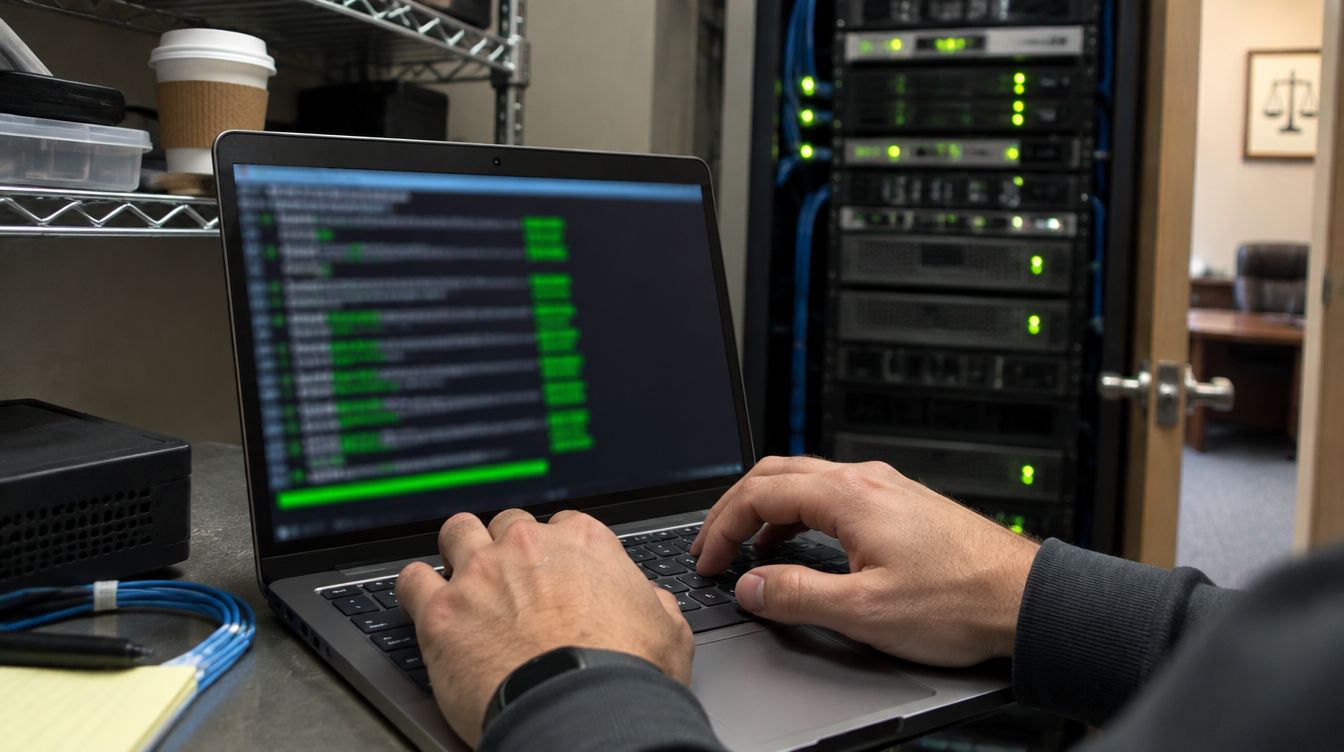
clearmaxdeployments.com belongs to ClearMax Labs. Its single subject is the technology inside an Atlanta law office: the wiring in the ceiling, the WiFi, the readers on the doors, the cameras over reception, the conference room screens, and the server and computers that sit on top. ClearMax technicians install all of it in person, as a project with a fixed scope that finishes, rather than as an open-ended service contract.
Last updated: November 2026
Typical Atlanta law office jobs
- Fit-outs. A firm has signed for new space and the general contractor is framing walls. Cabling, door wiring and the closet are designed against that construction calendar.
- Relocations. Equipment comes out of the old office on a Friday evening and is running in the new one by Monday, with every machine listed and any retired drive wiped or destroyed.
- Single-room projects. One records room gets a reader. One boardroom gets a screen with a real cable behind it. One flat network becomes two, firm and guest.
- Trades bought separately. Cabling and WiFi, card access or cameras alone, drawn so the other pieces slot in later.
- The machines. A server in the closet, or a hosted service instead, plus desktops and laptops prepared for the person who will sit at each one.
Where the job stops
Legal software is not part of it. Case management, time and billing, and document systems belong to their makers, who support their own products. ClearMax Labs sells none of them and has no tie to any legal software company. If a firm that is not a client has a system failure today, its existing IT provider is the right first call; this site handles planned projects.
Nor is any of this legal advice. Rules are quoted on these pages because they shape the design, each one linked to the place it was read. How a rule applies to a given firm is a matter for that firm's lawyers or the State Bar of Georgia.
Who usually calls
Firm administrators and managing partners at practices with anywhere from four or five lawyers to a few dozen, no internal IT staff, and a network built up piece by piece by people who are no longer around. They tend to learn what they have at the least convenient moment, such as move week or the morning a laptop disappears. A new office is the chance to reset: each cable, door and login written down, and each one owned by the firm rather than by an installer.
How an Atlanta project is run
- A note arrives through the contact page.
- Questions come back about the gaps: the plan, the number of people, move date, construction milestones, the equipment worth keeping.
- The firm gets a scope and a price in writing. Work is only scheduled once the firm says yes, and any growth in the job is raised with the firm before it is done, with a revised bid.
- Installation is fitted around hearings and deadlines, at night or on weekends where needed.
- The job closes with the handover record.
The handover record, and why it exists
Georgia's conduct rules expect lawyers to take care with what clients tell them, and care that left no trace is difficult to demonstrate later. Comment [24] to Rule 1.6 of the Georgia Rules of Professional Conduct says a lawyer should make reasonable efforts to prevent the inadvertent or unauthorized disclosure of, or unauthorized access to, information covered by the rule. The competence rule speaks in broad terms. Rule 1.1 asks for the legal knowledge, skill, thoroughness and preparation reasonably necessary for the representation. No equipment purchase meets either rule by itself. A clear record simply gives a partner something concrete to point to.
The record covers every cable run, reader, camera and access point; each network and its reach; every login and its owner; the server, where its backups go, and when a restore was last tried. Accounts and licenses are registered to the firm, and the document is the firm's to keep.