
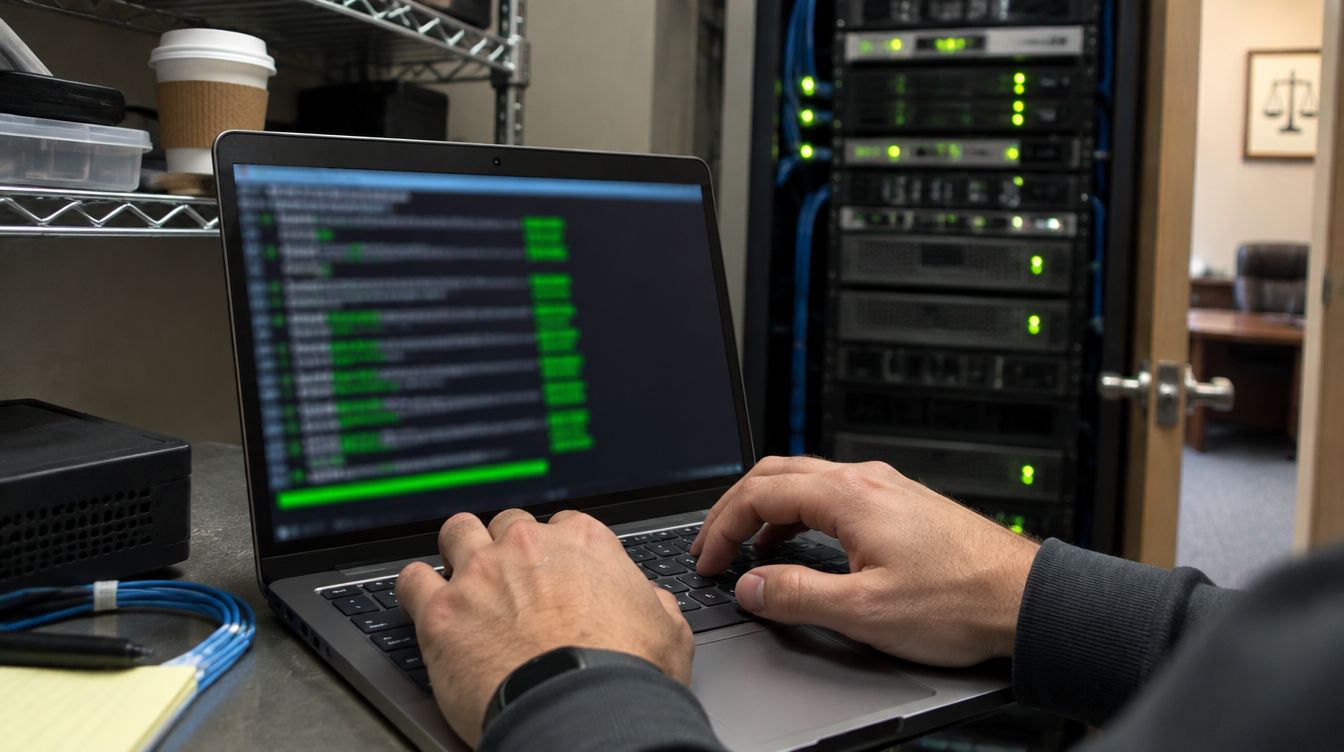
Network cabling in Atlanta for a law office is the wiring every other system depends on: one run from the network closet to each desk, conference room, copier, access point, door controller and camera, labeled at both ends and tested before handover. ClearMax technicians pull, terminate and test it on site, under a City of Atlanta low voltage permit, and plan the office WiFi on the same drawing.
Last updated: November 2026
Why start a law office move with the cabling?
Because it is the one part of the job that becomes expensive to change once the walls are closed, and because everything else plugs into it. Ceiling access points draw their power over a network cable. So do most cameras and many door controllers. The conference room screen needs a cable behind it before the wall is finished. If any of those runs is missing on move day, the fix is a ladder, a hole and a patch, often in a room the firm is already using.
So the project begins with the firm's floor plan and a drop schedule: a numbered list of every cable, where it starts, where it ends and what it serves. That schedule is the document the general contractor, the building engineer and the inspector all read, and it is the one the firm keeps after everyone has left.
How many drops does each room get?
It depends on how the firm works, but most Atlanta law offices end up close to this pattern:
| Space | Typical drops | The reason |
|---|---|---|
| Partner and associate offices | Two or three at the desk wall | Computer dock, desk phone, and one spare so a second printer or a docking change does not mean new wire |
| Large conference room | Four or more, split between the wall and the table | Display, video bar, a wired seat for presenting, and room to grow |
| Small conference or interview room | Two | A display or a phone, and a wired connection for the firm's own laptop |
| Reception | Two or three | The front desk computer, its phone, and the camera that covers the counter |
| Paralegal and assistant stations | Two per seat | The heaviest printing and scanning in the office |
| Copier and scanner alcoves | One per machine, plus one spare | Scanned documents stay on the wired office network |
| Records room | Reader and camera at the door | A log and a picture of who went in |
| Ceilings | One per access point and per camera | Power and data on the same run |
The total is then checked against the switch in the closet, both for the number of ports and for the power budget, so that every access point, camera and reader can run on day one with headroom left over.
What cable goes in?
For a law office being fitted out today, Category 6 to the desks and Category 6A to the ceilings is a common split. Category 6 comfortably carries what an office uses at the distances an office floor needs. Category 6A is heavier and costs more, and it earns its place on the runs to access points, which carry the most traffic and are the hardest to replace later. Plenum-rated jacket is used wherever the ceiling space is a return air path, which is common in Atlanta office towers.
Every run ends on a patch panel in the closet and a jack in the room, and both ends carry the same number. The numbering follows the floor plan rather than the order the cable was pulled, so that "the screen in the east conference room is dead" leads a technician straight to one port. Runs are kept within the standard's length limit, which is one reason the closet is placed near the middle of a long floor rather than at the far end beside the freight elevator.
Does Atlanta require a permit for office cabling?
Yes, for new installation. The City of Atlanta's permit guide limits its exemption for low voltage systems such as security alarms, phone and cable lines to existing single-family, two-family or duplex homes. An office floor is neither, so cabling, card access and cameras installed there are permitted work with an inspection to plan for.
Small repairs are treated differently. The same guide says no permit or permit fee is required for repair work to a non-residential structure below a set total valuation, provided the work is otherwise lawful. Replacing a damaged jack is a repair. Rewiring a floor for a new tenant is not, and the scope says which one the job is.
Timing matters too. The City has announced that permit operations stop from 5:00 p.m. on December 10 until 8:00 a.m. on December 21, 2026, while it moves to its new ATL OPAL system. A move planned for early January needs its permit filed before that window, or a schedule that allows for it.
How is the WiFi planned?
On the same drawing, at the same time, because each access point needs its own cable in the right spot before the ceiling grid closes. A law office needs two wireless networks that share the same access points and never touch:
- The firm network, for the firm's laptops, phones and tablets. It can reach the file server, the copiers and the printers.
- The guest network, for clients in reception and for opposing counsel, court reporters and witnesses who spend a full day in a conference room during a deposition. It reaches the internet and nothing else, and guest devices cannot see one another.
The separation is enforced at the firewall, not only by giving the two networks different names. A guest network that is merely renamed can still reach a shared printer or a mapped drive if nothing blocks it, and that is exactly the kind of gap nobody notices until a visitor prints to the firm's copier.
Access points are placed by room use rather than by square footage. Conference rooms get the strongest coverage because they hold the most devices at once. Private offices with solid doors and glass fronts each take a little from the signal, so a row of them needs more access points than an open area of the same size. Coverage is tuned to stay inside the firm's space as far as the building allows, so the guest network does not spill into the elevator lobby.
Anything that sits still and matters gets a cable instead of WiFi: copiers, the reception computer, conference room displays and video bars, desk phones, cameras and the server.
What goes in the network closet?
Every cable ends here, which makes it the most sensitive room in the office after the records room. A typical law office closet holds the patch panels, a switch that powers the access points and cameras, the firewall that keeps the guest network away from the firm's files, a battery that shuts the equipment down cleanly in an outage, and the server if the firm keeps one on site. The door gets a card reader and a log.
Heat is the other planning point. Many Atlanta buildings turn their air down after hours and on weekends, and a small closet full of running equipment warms quickly in summer. Ventilation or dedicated cooling is agreed with the landlord while the room is still on paper, not after the first warm Saturday.
How does cabling relate to client confidentiality?
Quietly, but in ways a firm can describe. Comment [24] to Rule 1.6 of the Georgia Rules of Professional Conduct says a lawyer should make reasonable efforts to prevent the inadvertent or unauthorized disclosure of, or unauthorized access to, information covered by the rule. Some of those efforts are physical and are decided when the cable is planned: copiers and scanners wired to the firm network rather than joined to WiFi, conference tables given a wired port for the firm's own laptops while visitors use guest WiFi, and unused wall jacks left unpatched in the closet so a stray cable plugged into one connects to nothing. None of this is legal advice; it is how the office is wired.
How is every run proven?
Each run is tested end to end with a cable tester after it is terminated. The test confirms the run meets its category, has every pair wired correctly and is within length. A run that fails is re-terminated or replaced before the ceiling closes.
At handover the firm receives four documents: the drop map with every jack on the floor plan, the test result for each run, the closet layout showing which switch port feeds which room, and the permit and inspection record. The WiFi is handed over with a coverage test from each room and a check from a guest laptop showing that the server, a shared folder and a copier are all unreachable from the guest network.
Can cabling be done in an office the firm already occupies?
Yes. Many firms start with one problem, such as a conference room that never had a wired screen or a records room that needs a reader, and the work is booked in the evenings or on the weekend, a room at a time. Older Atlanta buildings sometimes hide abandoned cable above the ceiling and fire-rated walls that must be sealed where new runs pass through. The quote is built from the floor plan and photos of the ceiling and closet. If the job proves larger than described, the firm hears about it before any extra work, and the bid is revised.
The access control page covers the doors that hang off this cabling, and the camera page covers what is recorded and where cameras never go.
Cabling and WiFi questions from Atlanta firms
Everyone uses laptops. Do we still need cable?
Yes. Access points, cameras, door controllers, copiers and conference room screens all need wired runs, and a docked laptop is steadier on a cable.
Can the old cable stay?
Runs that test clean and match the new layout can. Unlabeled cable usually takes longer to trace than to replace.
Should clients get a WiFi password?
A simple password given at reception keeps neighboring tenants off the guest network. It is changed on a schedule the firm chooses.
Who holds the WiFi and switch passwords afterwards?
The firm. Administrator access is recorded in the firm's name and handed over with the test results.